ESSAY / 2026
Exploring Conway's Game of Life
The first step toward understanding any system is simplification, i.e. to determine what features are minimally required for a specific part of a system and strip the original one of all other components and moving parts.
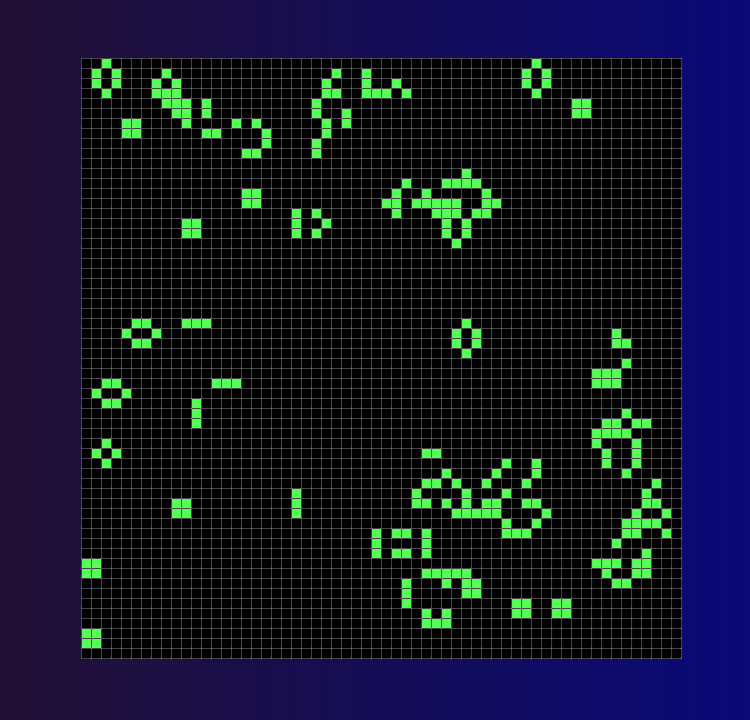
Fig. 1. Conway's Game of Life.
1. Game of Life
- A live cell with less than two neighbors dies (under-population).
- A live cell with two or three live neighbors passes onto the next generation.
- A live cell with four or more live neighbors dies (overpopulation).
- A dead cell with three neighbors becomes alive (reproduction)
Vid. 1. Conway's Game of Life.
The game of life is an example of a cellular automation. It is a computational model that simulates the evolution of a system based on simple rules (simplification). If we populate the grid randomly with cells that are alive, and let the system run, we can see beautiful and mesmerizing patterns emerge. Some patterns give way to new ones. Some are doomed to die, while others persist.
It is fascinating to see such complexity emerging out of simplicity. But we should not be overwhelmed by this. Even in basic simplifications such complications could occur. People have been trying to identify these patterns. We shall now go through some of the most interesting ones to see how they behave.
1.1. Still lives
Still lives are patterns that simply exist and persist, unless affected by neighboring patterns (see Fig. 2).
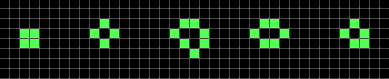
Fig. 2. Still lives. From left to right: Block, Tub, Loaf, Beehive, Boat.
1.2. Oscillators
There are some patterns, which pulsate and go back to the same state after one or more generations, without their initial position changing (see Fig. 3).
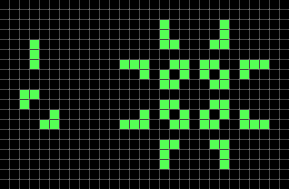
Fig. 3. oscillators. Top-left: Blinker, Bottom-left: Beacon, Right: Pulsar.
1.3. Spaceships
There are some patterns , which pulsate and go back to the same state after one or more generations, but they do not stay still. The pattern moves in a direction (see Fig. 4).
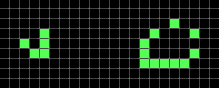
Fig. 4. Spaceships. Glider (left) and a lightweight spaceship (right).
1.4. Other patterns, generators, guns
To this day, new patterns are being discovered by enthusiasts. For example, the pattern "Gosper glider gun" (see Fig. 5) is able to produce a glider (see Fig. 4 left) every 30th generation after launching the first one. Some patterns take much longer to repeatedly generate a pattern and some are too big to fit in an arbitrary canvas. As a rule of thumb, the more complex a repeating pattern, the harder it gets to discover another pattern, which generates it.
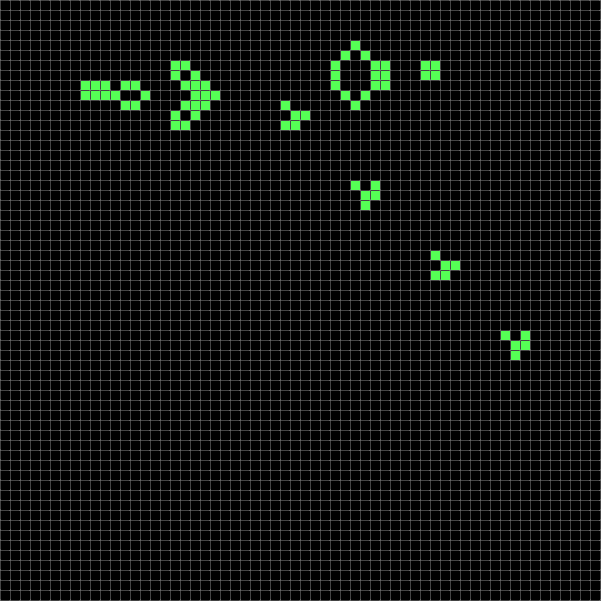
Fig. 5. Gosper glider gun.
2. Conclusion
Conway's Game of Life shows how sometimes even the simplest rules can cause very complex and unpredictable behavior. It means complexity does not necessarily always require sophisticated designs and rules of engagement. It shows patterns can emerge, evolve, collapse and reemerge, solely based on interactions. It is a true lesson that echoes across physics, chemistry, and eventually life.
Ever since its introduction in 1970, many people have discovered engaging patterns and there are tons more to be discovered, all of which are a "search" and a few blocks of code away. What if the rules are slightly different? What if the state of the cells is more than just 1 or 0? What if inspired by the Game of Life, we look at other problems in science, mathematics and social studies and try to simplify the system, in order to have a better understanding?
Some of these questions have already been explored extensively, but what if there are other questions that we have not asked yet? What is the "correct" question? That is yet to be seen.